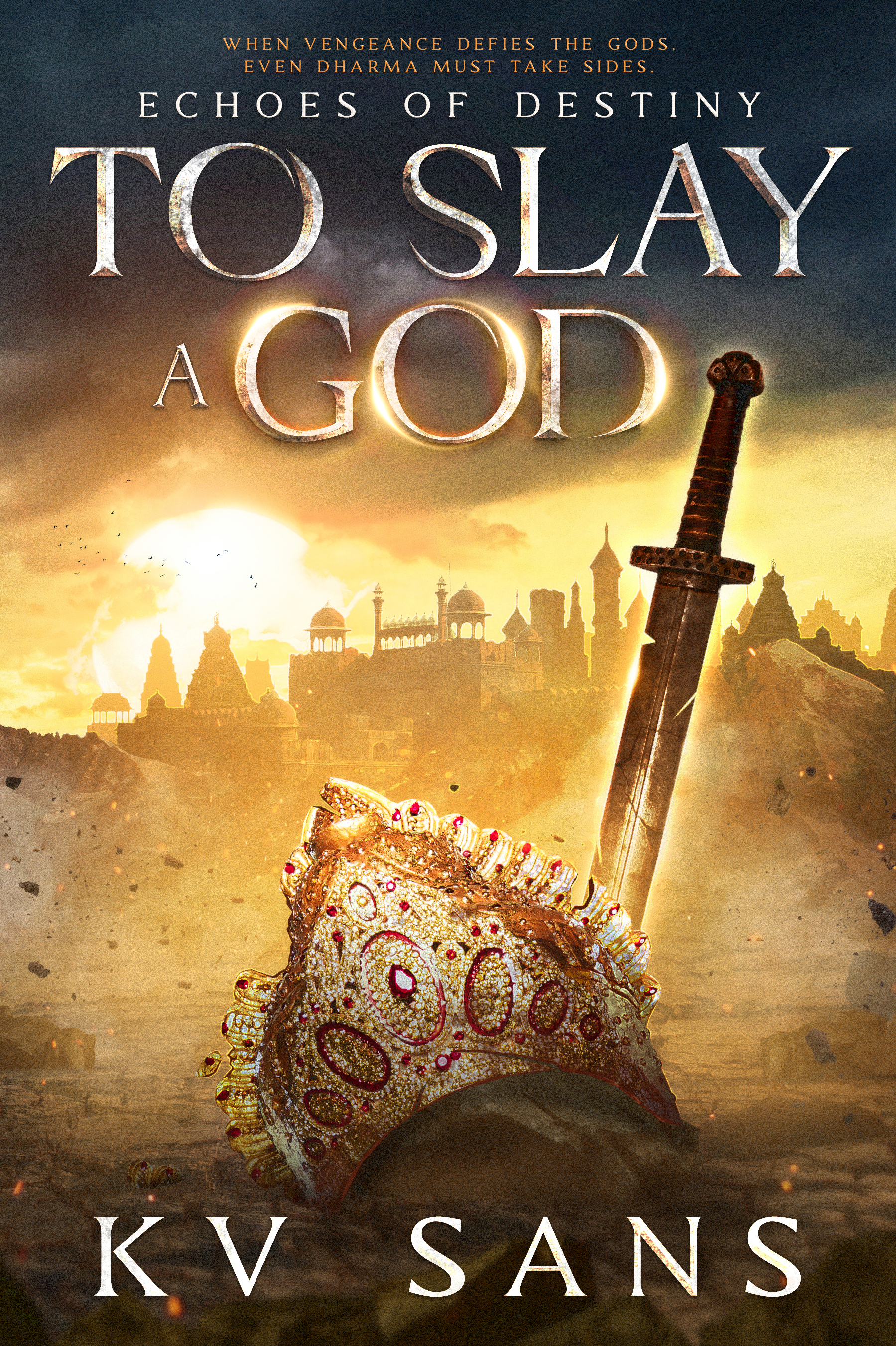
When vengeance defies the gods.
Even dharma must take sides.
"The dharma of a king is not the dharma of a man."
In the twin kingdoms of Mund and Prakhand, power is not seized. It is inherited, consecrated, and slowly corrupted by the weight of what it asks its holders to become.
Echoes of Destiny is the story of what dharma demands when the gods are not watching — and what it costs those who answer. A king who has run out of lawful moves. A strategist dismissed by every institution that formed her. A commander carrying a wound no one is permitted to name.
And a man who believes himself righteous — which makes him the most dangerous force in the known world.
A man of order confronting a moment that order cannot contain. He does not want to be the kind of king who does what he is about to do — which is precisely why it falls to him.
She sees the shape of things before others have named them. The institutions that formed her underestimate her. They always have. This is no longer their advantage.
His loyalty is a kind of architecture. It holds even when the weight placed upon it exceeds what the builder intended. His wound is private. Its cost is not.
Four bangles on her wrist. One always missing. The count is hers — the mark is hers. She governs through intelligence, not authority. That is the harder kind.
The dharma of a king is not the dharma of a man. When the crown is placed upon the head, something is taken from the one who wears it — and what is taken does not return. Shirpu had known this since boyhood. He had not known, until this moment, that the taking was not finished when the ceremony ended. It continued. Quietly. Season after season. Until the day it asked for the remainder.Echoes of Destiny · Chapter One
Three books. Three acts of consequence. The world does not reset between them. The choices made in Echoes of Destiny ripple forward — as they must, in a world where dharma is not a comfort but a demand, and where what is done in the name of right does not undo itself.
The first act. A king discovers that the only lawful response to Rajisura of Prakhand is one that cannot be made lawfully. What follows will define everything that comes after.
The second act. What was set in motion cannot be recalled. Those who remain must carry what the first book made of them.
The question the series began with. Whether dharma restores. Whether the self survives its own righteousness. The answer has not yet been written into the world.
Every world has its grammar — the rules by which consequence moves, by which power is transferred, by which the sacred and the political are kept in orbit around each other.
Dharma in this world is not virtue. It is the shape of obligation that falls on a person by virtue of their station, their lineage, their moment in time. The dharma of a king is different from the dharma of a mother. These do not reconcile easily.
Mund is enclosed, devotional, warm — a world of courtyards and accumulated ritual. Prakhand is wide, martial, exposed — a kingdom that understands power as projection. Their collision is not metaphorical. It is physical, political, and sacred at once.
Kaya wears four bangles. A fifth is missing. She is the only one who counts. The absence is not hidden — it is worn. To notice is to be trusted with what she has chosen not to explain.
The serpent appears three times across the series — once in each book, each time in a different register. In Echoes of Destiny, it is a natural creature. In Book Two, a symbol. In Book Three, something older than either.
The crack appears before the breaking. Every blade used faithfully carries in its metal the memory of the force it was asked to bear without being told to break. The crack is the blade's proof of service.
It arrives when an action has been completed and the room does not yet know how to hold what has been done in it. It cannot be named because naming it would be a form of processing — and it must not be processed. Only inhabited.
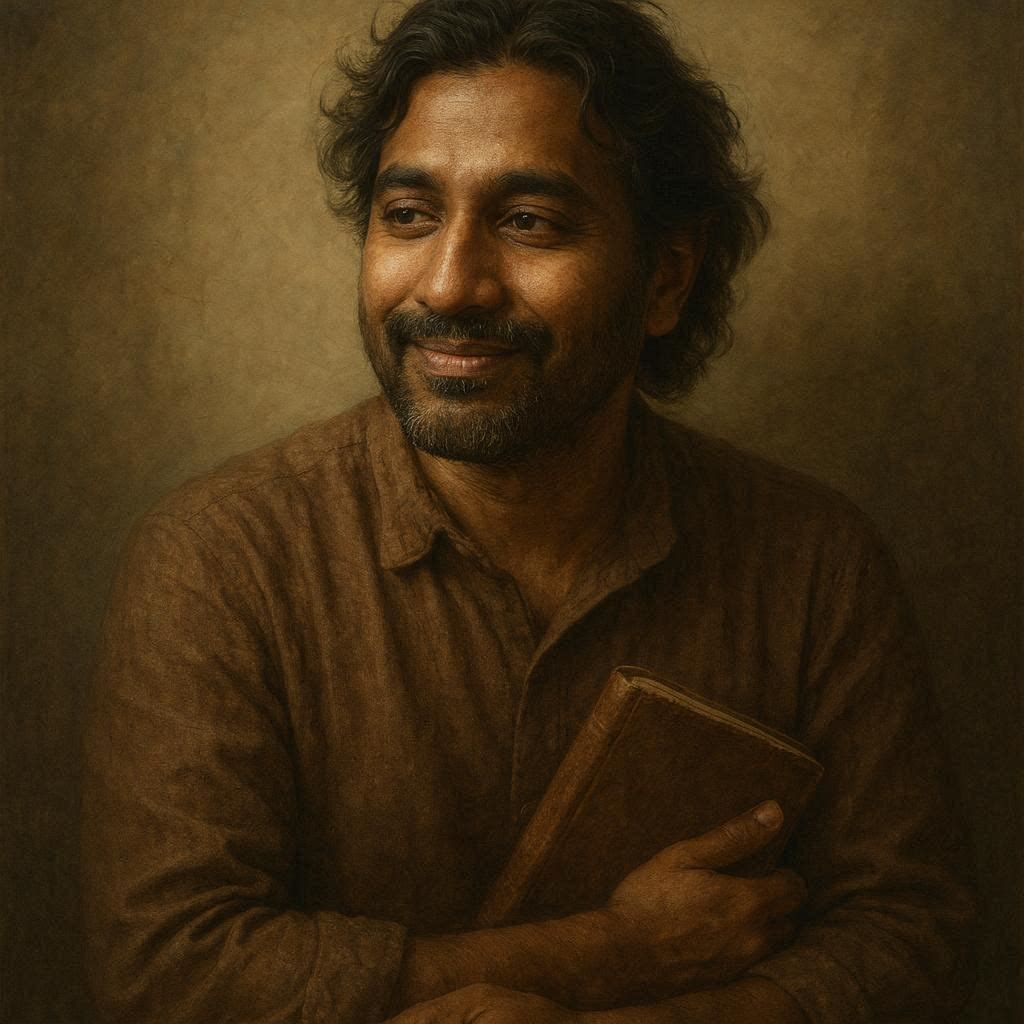
KV Sans writes mythic fiction at the intersection of dharma and consequence — where doing what is right does not restore you to who you were before you had to do it.
"I am not writing about a world that existed. I am writing about the kind of world that requires the people in it to become exactly who they are — and asking whether that is a gift or a cost."
The To Slay a God series grew from a single question that refused to resolve: Does doing the right thing restore a person to who they were before they had to do it? This is not a question the tradition of dharma answers comfortably. It is a question the tradition lives inside.
KV Sans writes from deep engagement with South Asian history and its living philosophical inheritance — not as a curator of the exotic, but as someone for whom these traditions are a primary grammar of meaning. The world of Mund and Prakhand is not a recreation. It is a consecration.
This page contains everything a journalist, reviewer, podcast host, or bookseller needs. Response time is typically five to seven business days.
High-resolution cover image, author biography (short and extended), book description, and series overview — all in a single downloadable PDF.
Dharma as narrative engine. Writing mythic fiction without exoticism. The antagonist who believes himself righteous. The Sanskrit aesthetic of compression and implication.
Advance reader copies are available for qualified reviewers, bloggers, and book clubs. Please include your platform and readership in your message.
For press inquiries, foreign rights, event invitations,
and general correspondence: